
Free IQ Test: Find Your IQ and Thinking Style
Solve 32 puzzles across four kinds of reasoning: pattern matrices, number series, letter series and mental rotation. You see your IQ, its likely range, your percentile and your thinking style the moment you finish, free and with no email.
32 puzzles25 minutesFree score, range + mind profileNo email
More than a number
Your score is the headline. How you got there is the story.
Two people can both score 115 and think in very different ways. One sees the answer to a shape grid at a glance. The other works through a number series step by step and checks every rule. This free test gives you your IQ estimate with an honest range, and also reads how you solved the puzzles: which of the four types suits your mind, how fast you think, and how far you can stretch before a puzzle beats you. No email, no account.
What your IQ score says about your mind
Your result names the puzzle type you did best on, measured against your own overall level. A pace label and your peak level complete the picture. Which one are you?
The Pattern Spotter
Strongest on the shape grids. You grasp structure visually and often see how the pieces fit before you can explain why.
The Number Cruncher
Strongest on number series. You test a rule, check it against every number, and adjust when it breaks.
The Sequence Tracker
Strongest on letter series. You keep a sequence in your head and follow two moving rules at once.
The Spatial Navigator
Strongest on mental rotation. You turn a shape in your mind and tell a true turn from a mirror image.
The All-Round Reasoner
Strong and even across all four types. You switch between patterns, rules and shapes without losing ground.
The Balanced Thinker
Your four types sit close together. No single style leads, so practice on any of them lifts your score evenly.
What you see when you finish
Your IQ estimate with its likely range, your place on the bell curve, a result for each of the four puzzle types, and a short profile of how you think.
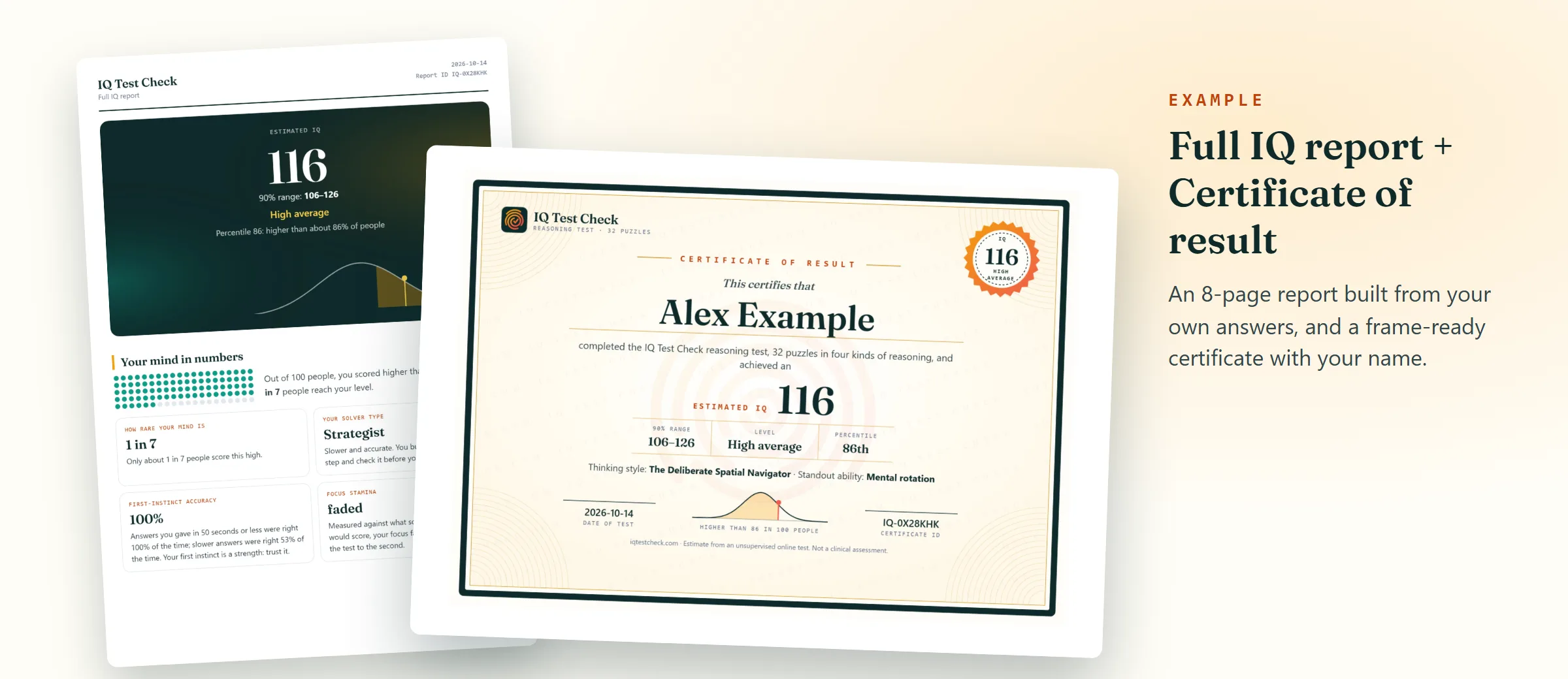
All of that is free. The optional full report goes further: how rare your result is, your solver type, whether to trust your first instinct, your focus stamina and every puzzle explained, plus a certificate of result with your name.
Example result
Example mind profile
The Steady Number Cruncher
Best on number series for this level, at a pace that leaves time to check each rule.
An example result. Your own report is built from your own answers. We show a range because no short IQ test is exact.
What is an IQ test?
A set of reasoning puzzles, scored against how people in general perform.
An IQ test measures how well a person reasons with new information: spotting rules, holding them in mind and applying them. The result is a standard score. By convention the average is 100 and the standard deviation is 15, so about two in three people score between 85 and 115.
IQ stands for intelligence quotient. Early tests divided a child's "mental age" by their real age. Modern tests compare each person with norms from a large group instead, which is why a score of 100 means exactly average at any adult age.
This test uses four of the puzzle families found in research tests. It does not test knowledge, vocabulary or school maths, so it cannot be studied for like an exam.
What each puzzle reveals about how you think
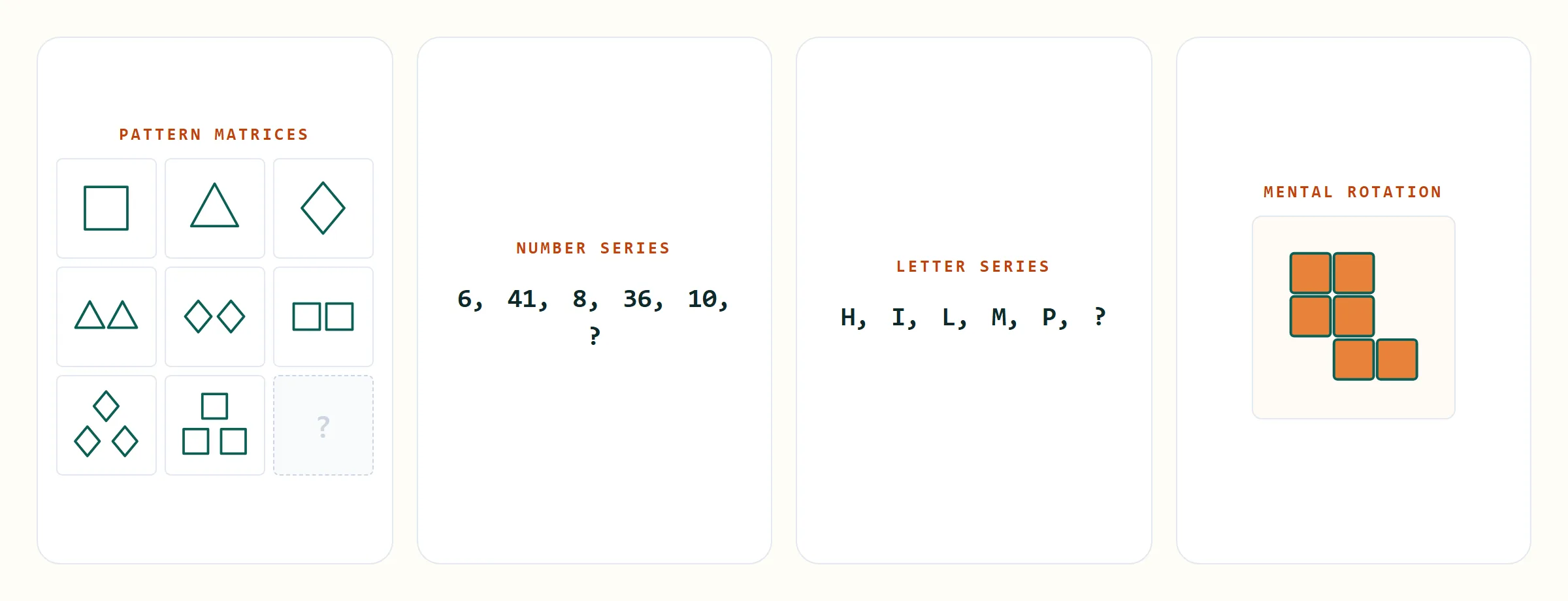
Four puzzle types, eight of each, six answer options per puzzle. No maths beyond the basics and no general knowledge.
Code builds a new set for every test, so nobody can learn the answers in advance.
Pattern matrices 8 puzzles
A three-by-three grid of shapes with the last cell empty. These show how well you see structure: rules across rows and down columns at once.
Number series 8 puzzles
Five numbers and a gap. These show how you hold a rule in your head, test it, and change it when the numbers do not fit.
Letter series 8 puzzles
Five letters and a gap. These show how you track positions and steps, often with two series taking turns.
Mental rotation 8 puzzles
One shape and six candidates. Only one is the same shape turned; the rest are mirror images or near misses.
Warm-up puzzle
Which number comes next? 2, 6, 12, 20, 30, …
See the solution
42. The gaps are 4, 6, 8 and 10, so the next gap is 12. Each number is also n × (n + 1): 1×2, 2×3, 3×4 and so on.
A warm-up, not one of the test puzzles.
What your IQ score means
Your result places you on a bell curve. The average IQ is 100, half of all people score between 90 and 109, and each 15 points is one standard deviation from the middle.
| Score | Range name | Percentile | % of people |
|---|---|---|---|
| 130 and above | Very Superior | 98th and above | 2.3% |
| 120 to 129 | Superior | 91st to 98th | 6.8% |
| 110 to 119 | High Average | 75th to 91st | 16.1% |
| 90 to 109 | Average | 25th to 75th | 49.5% |
| 80 to 89 | Low Average | 9th to 25th | 16.1% |
| 70 to 79 | Borderline | 2nd to 9th | 6.8% |
| 69 and below | Extremely Low | 2nd and below | 2.3% |
The level names come from the Wechsler scales (WAIS-IV). A percentile is the share of people who score below a given result: the 75th percentile is higher than about 75 in 100 people. A "good" IQ depends on what you compare it with, but anything from 110 up is above average, and 130 or more is reached by about 2 in 100 people.
The ranges are conventions, not hard lines. A 119 and a 121 reflect almost the same performance, which is why every result comes with a likely range as well as a number.
Built to IQ test standards
Online IQ tests vary a lot. We followed the structure of established reasoning tests, not their questions.
- 1
Four kinds of reasoning
Pattern matrices, number series, letter series and mental rotation. The public-domain ICAR research test uses matrix reasoning, letter and number series and rotation items too; we use number series in place of its verbal items.
- 2
Rising difficulty
Puzzles go from level 1 to level 4, as in Raven's Progressive Matrices, where each set gets harder. Each level adds one more rule to track.
- 3
A real time limit
32 puzzles in 25 minutes, about 47 seconds each. Mensa's online challenge gives 35 puzzles in 25 minutes; Raven's Advanced Progressive Matrices is often given with a 40-minute limit.
- 4
One right answer, checked by code
Every puzzle is generated for your test, then checked so exactly one of its six options fits the rules. Wrong options are near misses, not random fillers.
- 5
An honest range
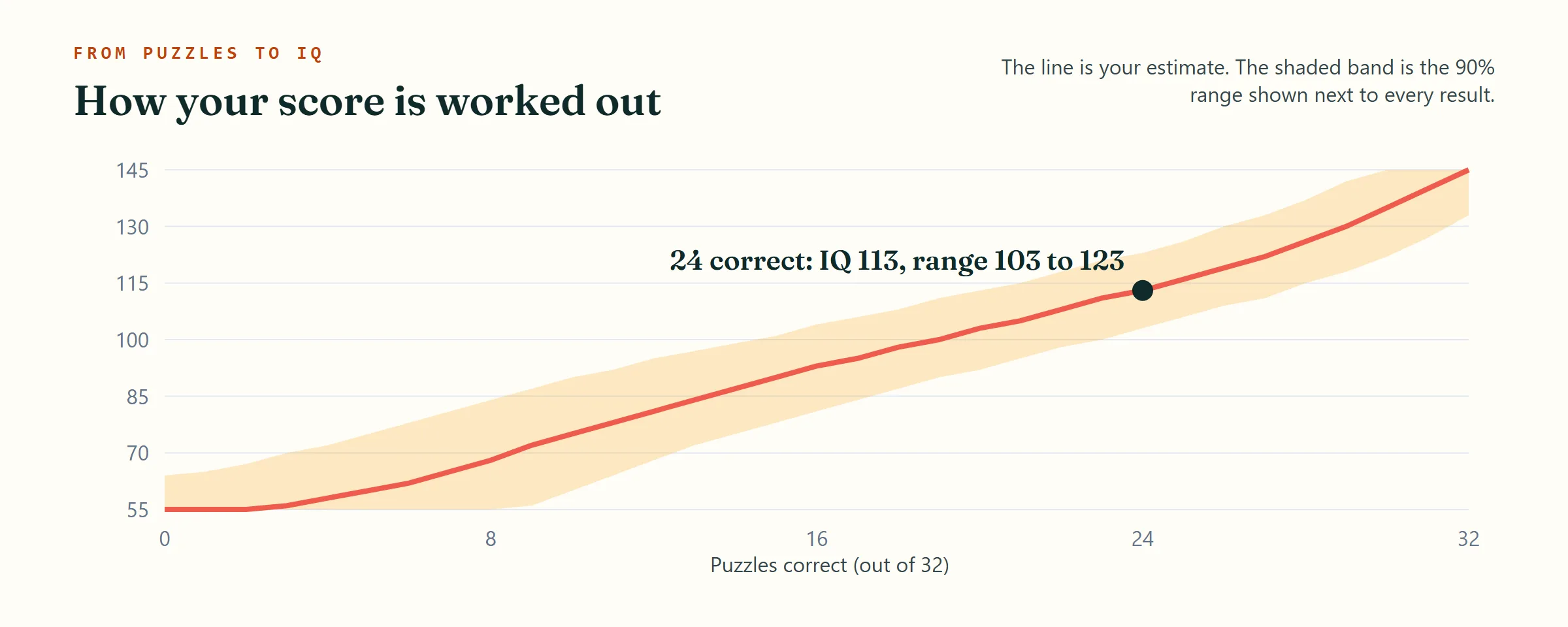
Scoring uses item response theory: your number correct is placed on the IQ scale using how hard each puzzle level is. You get a 90% range, not just one number, because no short test is exact.
Puzzle difficulty values are provisional until we calibrate them on real results. Every step is documented with sources.
How accurate is this IQ test?
Accurate enough to place you on the scale, not exact enough to hand you a clinical number.
Every IQ test, including the ones psychologists use, has measurement error. A short online test has more of it, which is why it is shown instead of hidden: your result comes with a 90% range. On simulated takers with a known true IQ, the range contains that true IQ about 9 times in 10.
Three things limit the accuracy of any online IQ test, ours included:
- No supervision. Nobody controls noise, tiredness or a second attempt.
- Practice. Scores rise a little on a retake because the puzzles feel familiar.
- Calibration. The puzzle difficulty values are provisional. They will be refitted on real results, with the date and sample size published.
How the accuracy was checked. Before launch, 64,000 generated puzzles were each confirmed to have exactly one answer that fits the rules. Then 3,500 simulated takers at known levels from IQ 70 to 130 were scored. When the puzzles behave as the model expects, the average error stayed within 2 points at every level, and the 90% range held the true value in 91 to 96 of every 100 cases. If real puzzles turn out harder than our provisional values, high results read a few points low. Calibration on real takers will correct that, and the reliability figures will be published once that data exists.
If you need an official IQ for school, work or a diagnosis, see a qualified psychologist.
IQ and personality: what is linked, and what isn't
People often read a lot into an IQ score. Research supports some links and rules out others. Here is the honest version.
Modestly linked to IQ
- Curiosity about ideas. People who score higher tend, on average, to score a little higher on openness to ideas.
- Enjoying hard problems. Liking puzzles and complex thinking goes with doing well on them, at least a little.
- Learning new, complex material. IQ tests predict how fast people pick up complex tasks at school and work.
Not decided by your IQ
- Kindness and empathy. A high score says nothing about how you treat people.
- Introvert or extravert. How social you are is largely separate from reasoning ability.
- Confidence, drive and grit. These shape what you do with your ability, and the test cannot see them.
- Your worth. A score describes how you did on a set of puzzles, on one day.
These links are averages across many people. They are not rules for any one person.
Let your mind show its best: 5 tips
Your score and your profile are only as fair as the conditions you take the test in.
- 1
Clear 25 minutes
The clock starts at your first answer. Mute notifications and close other tabs first.
- 2
Treat each grid as a rule
See what changes along a row, then check that the same rule works down each column.
- 3
Write down the gaps
For number and letter series, note the step between neighbours. For letters, count positions (A = 1). If the steps change, look at how they change.
- 4
Keep moving
Later puzzles are harder. If one stalls you, skip it or pick your best answer. You can come back while time remains.
- 5
Your first try counts
Retakes score a little higher because the format feels familiar. Your first calm attempt is the fairest picture of your mind.
Only a psychologist can give a clinical IQ. An online test gives an estimate.
Free, with one optional report and certificate
The test and your score are free. Nothing you see on the results screen is held back.
Free, always
- The full 32-puzzle IQ test
- Your IQ score and its 90% range
- Where you rank, and your level
- Results for all four puzzle types
- Your thinking-style profile
Full IQ report + Certificate of result · $8.99
- How rare your mind is, and your solver type
- Your first-instinct accuracy and focus stamina
- Whether your second thoughts help or hurt you
- Your reasoning ceiling and hidden strength
- Your cognitive fingerprint and every puzzle explained
- A frame-ready certificate with your name
One-off payment. No subscription, no trial, no recurring charges.
Common questions about this IQ test
Short answers to what people ask before and after they take the test.
Is this IQ test really free?
Yes. The full test, your IQ score, its likely range, your percentile, your results for each puzzle type and your thinking style are all free. The only paid item is the optional full IQ report plus a certificate of result, both as PDFs, for $8.99 as a one-off payment, with no subscription.
How long does the IQ test take?
The test has 32 puzzles and a 25-minute time limit, about 47 seconds per puzzle. The clock starts at your first answer. You can skip a puzzle and come back while time remains; puzzles left unanswered count as wrong.
Do I need an email or an account?
No. You do not need an email address, an account or a sign-up to take the test or to see your score.
What is a good IQ score?
The average IQ is 100. Results from 110 to 119 are high average, 120 to 129 superior, and 130 or more very superior, which about 2 in 100 people reach. Whether a result is good depends on what you compare it with.
What is the average IQ score?
By definition the average IQ is 100. Half of all people score between 90 and 109, and about two in three score between 85 and 115.
How is my IQ score calculated?
We use item response theory. Each puzzle level has a difficulty value, and your number of correct answers is placed on the IQ scale using those values. The same number correct always gives the same result, and you also get a 90% range that shows how precise the estimate is.
Why does my result show a range?
No short test can measure anyone exactly, so we show where your true level most likely sits. The 90% range means that 90 out of 100 people with your answers would have a true IQ inside it. A longer, supervised test narrows the range.
How accurate is this IQ test?
It gives an estimate with a 90% range, not an exact clinical number. Online tests are unsupervised, retakes score a little higher, and our puzzle difficulty values are still provisional until we calibrate them on real results.
Can I retake the IQ test?
Yes. Each test is built from new puzzles. Expect a small rise on a retake from familiarity alone, so your first calm attempt is the fairest reading.
Is this IQ test for adults or children?
It is designed for adults and older teenagers, and the scale compares you with the general adult population. Children's IQ is measured with tests normed for their age, such as the WISC, given by a psychologist.
How does this compare with the WAIS, Stanford-Binet or the Mensa test?
The WAIS and Stanford-Binet are clinical tests given one to one by a trained examiner, and Mensa admits members on supervised tests. Our test is an online estimate. It is a useful warm-up and a fair indication, but it does not replace an official score.
Can you improve your IQ?
Practice makes you better at familiar puzzle types, so your score on those puzzles can rise. Lasting gains in underlying reasoning ability are much smaller and still debated by researchers.
Can I take the test on my phone?
Yes. The test works on phones, tablets and computers. A larger screen makes the shape puzzles a little easier to read.
What happens to my answers?
Your answers are scored in your browser, and you do not give us your name or email. We may keep anonymous answers, with no personal details, to improve the scoring, as set out in our privacy policy.
Where to go next
Guides that explain your number, and how we built the test.
About this test

The test, the scoring and the guides on this site are written by Gareth Roberts, a psychologist in Cardiff with 11 years of experience in intelligence, personality and cognitive psychology. We review the method when new results come in and date every change.